
Mount Shuksan
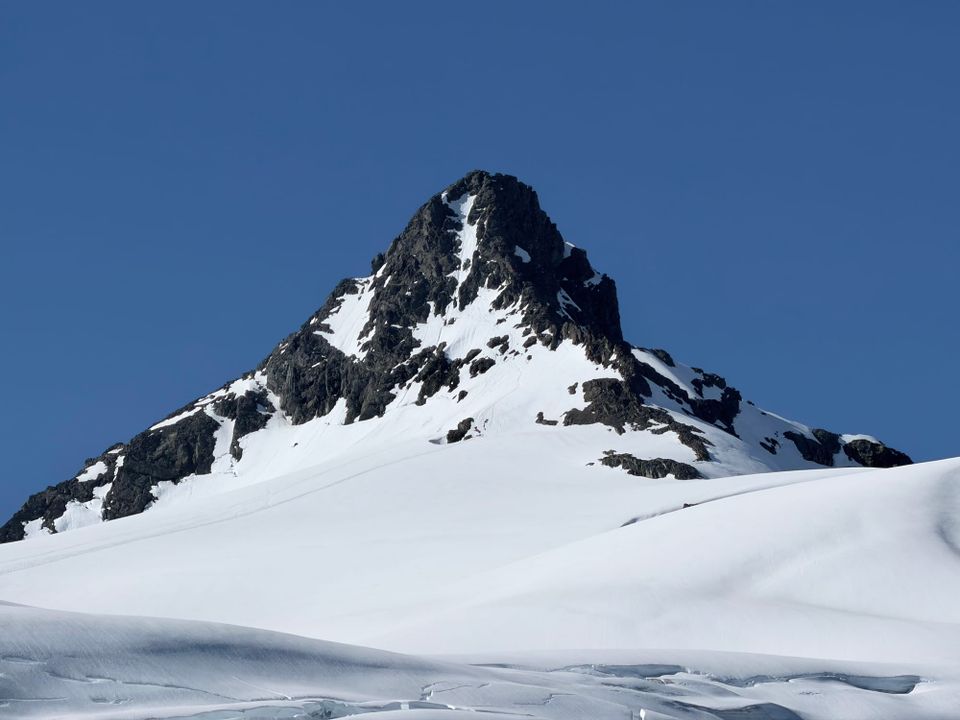
My first encounter with Mount Shuksan came while standing on the summit of Mount Baker in 2021, my eyes drawn eastward to its pyramidal form and my thoughts to the possibility of climbing it someday. The first opportunity came with the Mountaineers in 2022, but our team turned around at the base of the summit pyramid due to icy conditions. This fulfilled the basic climbing class requirements but I was still motivated to climb this magnificent shard of rock. When the opportunity to join another Mountaineers climb came this year, I didn't hesitate. Actually I hesitated a little, because the climb would coincide with the World Cup and I wanted to watch the US men's team play Australia. My climbing and football interests wrestled with each other briefly, but climbing won and I accepted the invitation.
We met in Olympia at 6:00 AM, dividing into two cars for the long trip to the trailhead. I rode with Cameron, who in addition to driving, acted as DJ and played classic Beach Boys tunes for much of the trip. By the end, we were singing along to Good Vibrations and hoping the climb would provide more of the same.
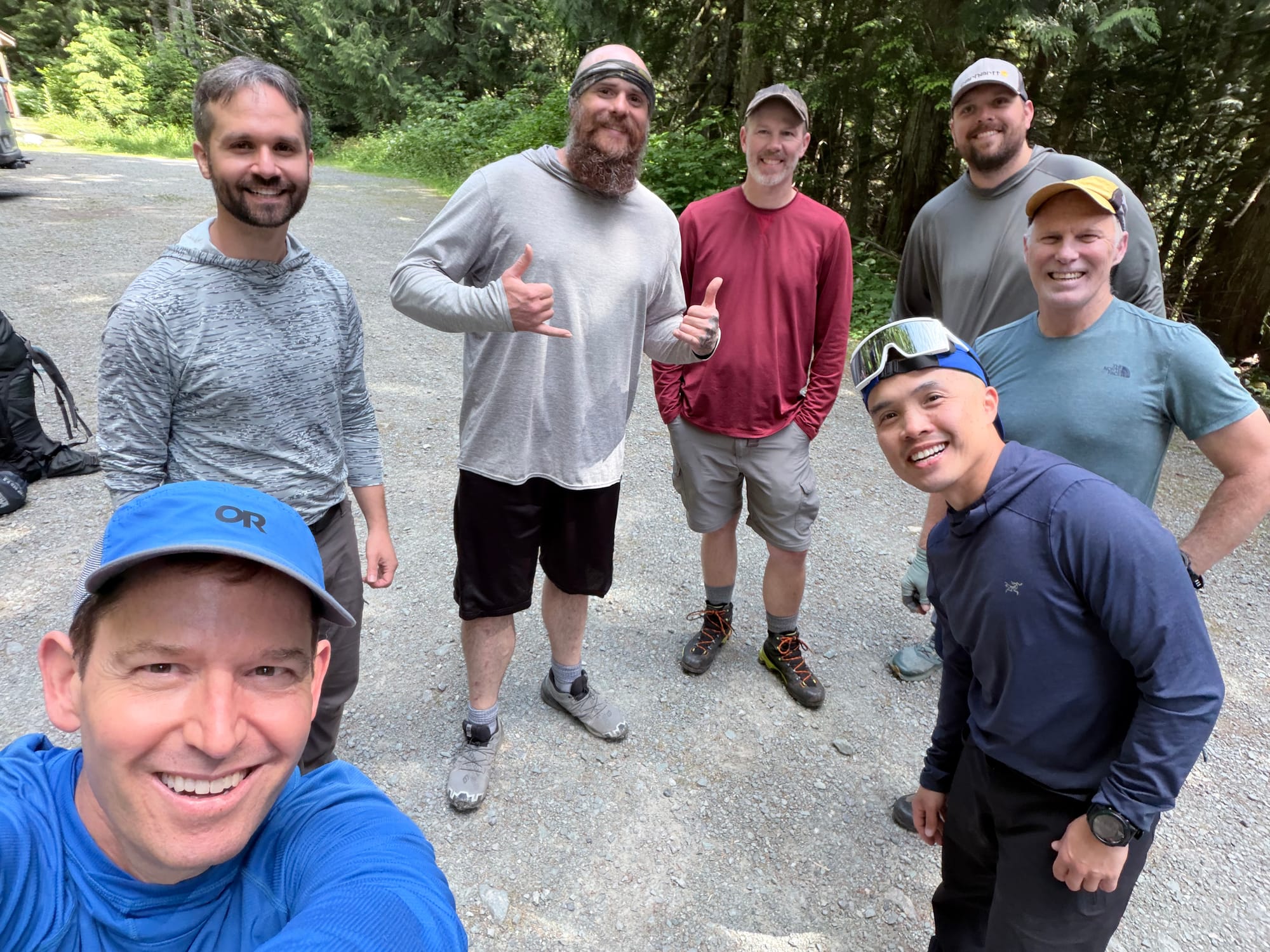
The road to the trailhead was in reasonably good condition, with some potholes that are avoidable with careful driving. When we arrived, there were three other cars, one a Subaru containing a climber sleeping in the back with the hatch open. I wondered if he was pre- or post-climb but either way, he remained blissfully unaware of our presence. We found the trailhead toilet well-stocked and clean, always nice to see in a place so remote as this. After dividing the group gear, we posed for a group photo before heading out at 10:30 AM in mid-70 degree weather.
Knowing we had all day to climb the 5 miles and 3,700 feet to camp and that there wouldn't be any shade when we arrived, we set a leisurely pace. When we encountered snow around 4,700 feet, some of us stashed our trail runners and switched to mountaineering boots.
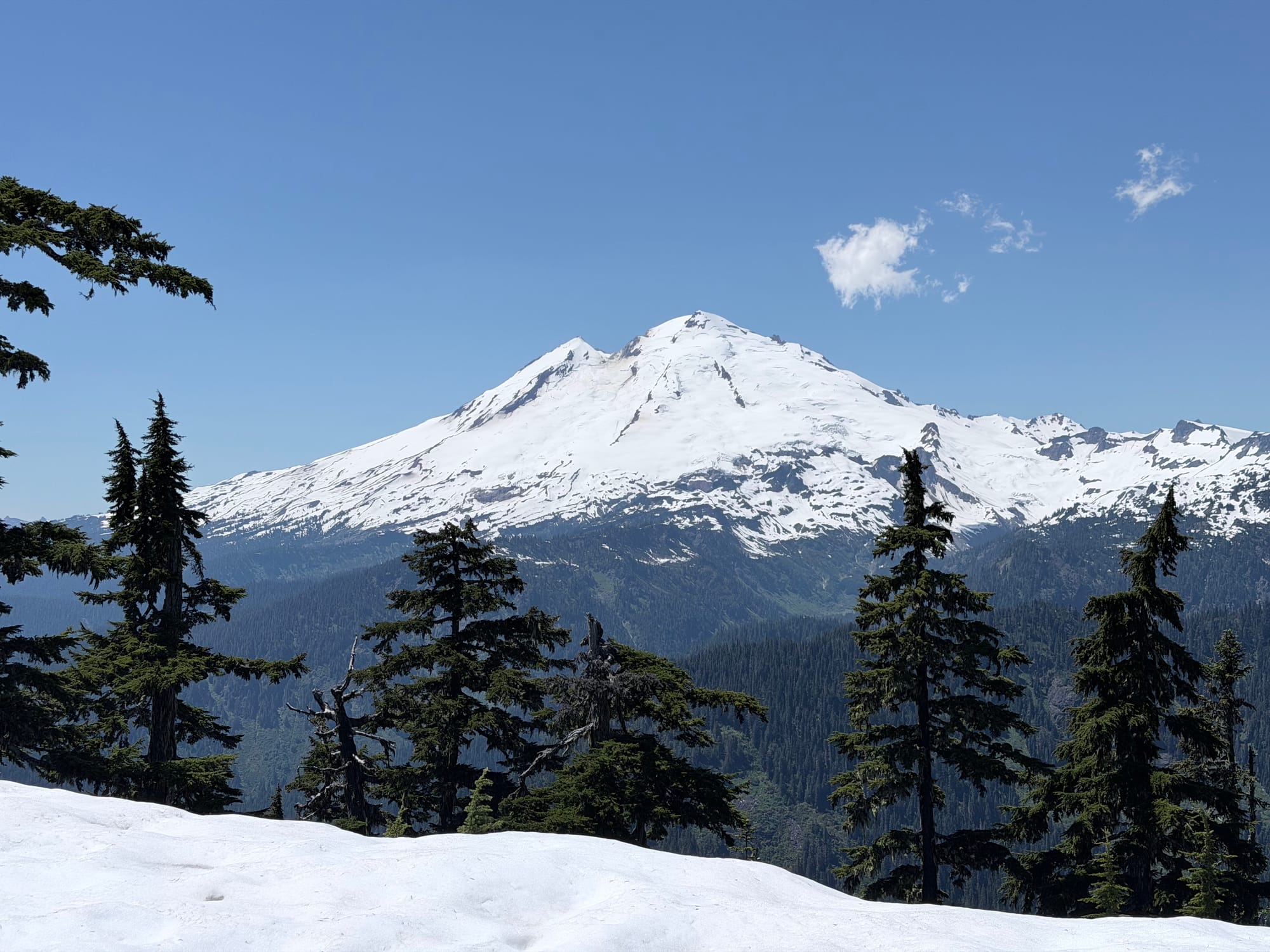
As we wound our way into the subalpine terrain, we were treated to expansive views of Mount Baker to the west.
At one point I realized that I still had cell service and wondered if I could stream the USA-Australia game. Unbelievably, this worked and I was able to listen through my AirPods while we hiked, providing updates to the team as the game progressed (USA won 2-0). I've never had cell reception this strong in the backcountry, for once T-Mobile coming through with excellent coverage. Normally I try to minimize use of my cell phone during a backcountry trip, but I had to make an exception in this case.
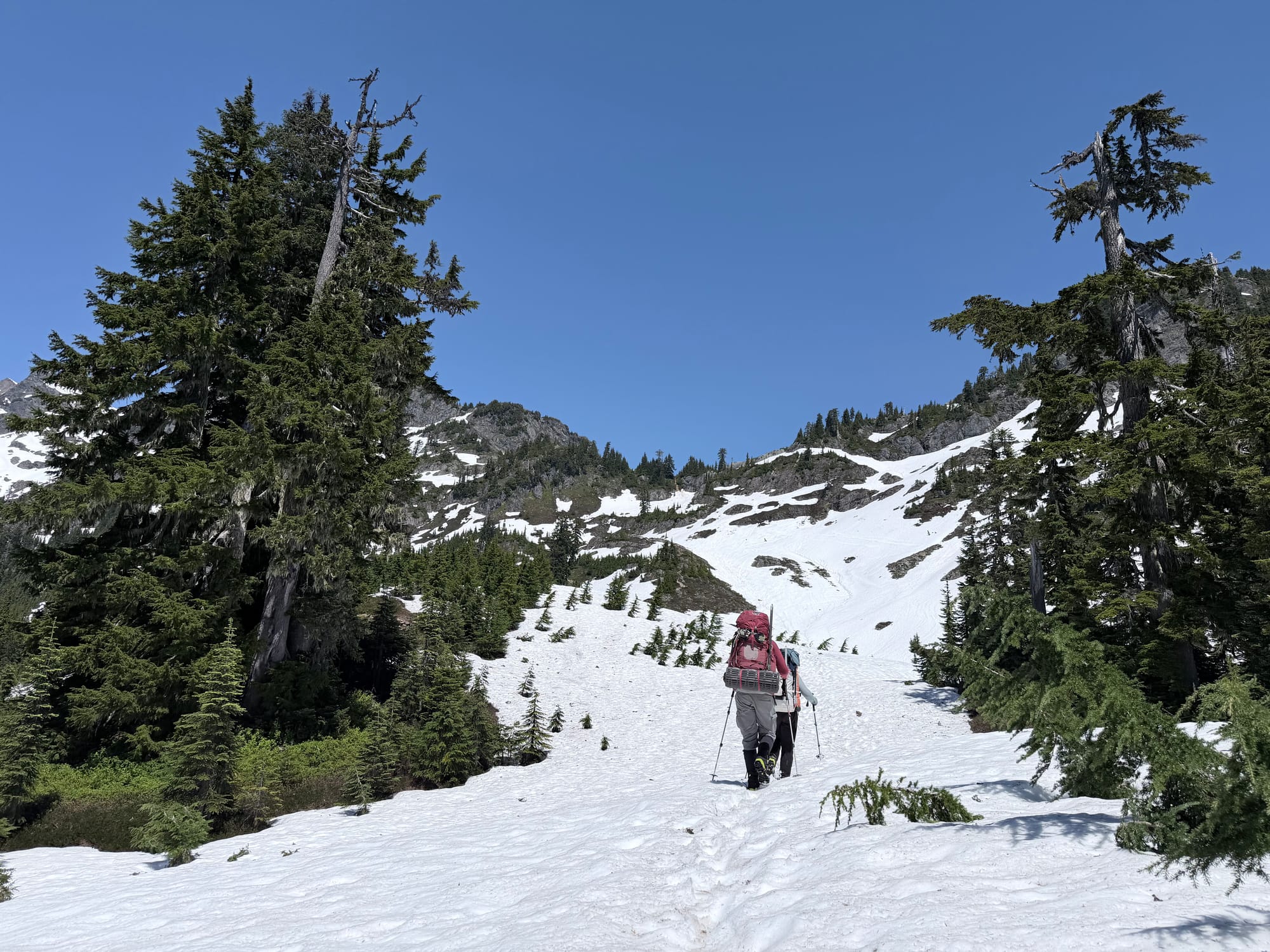
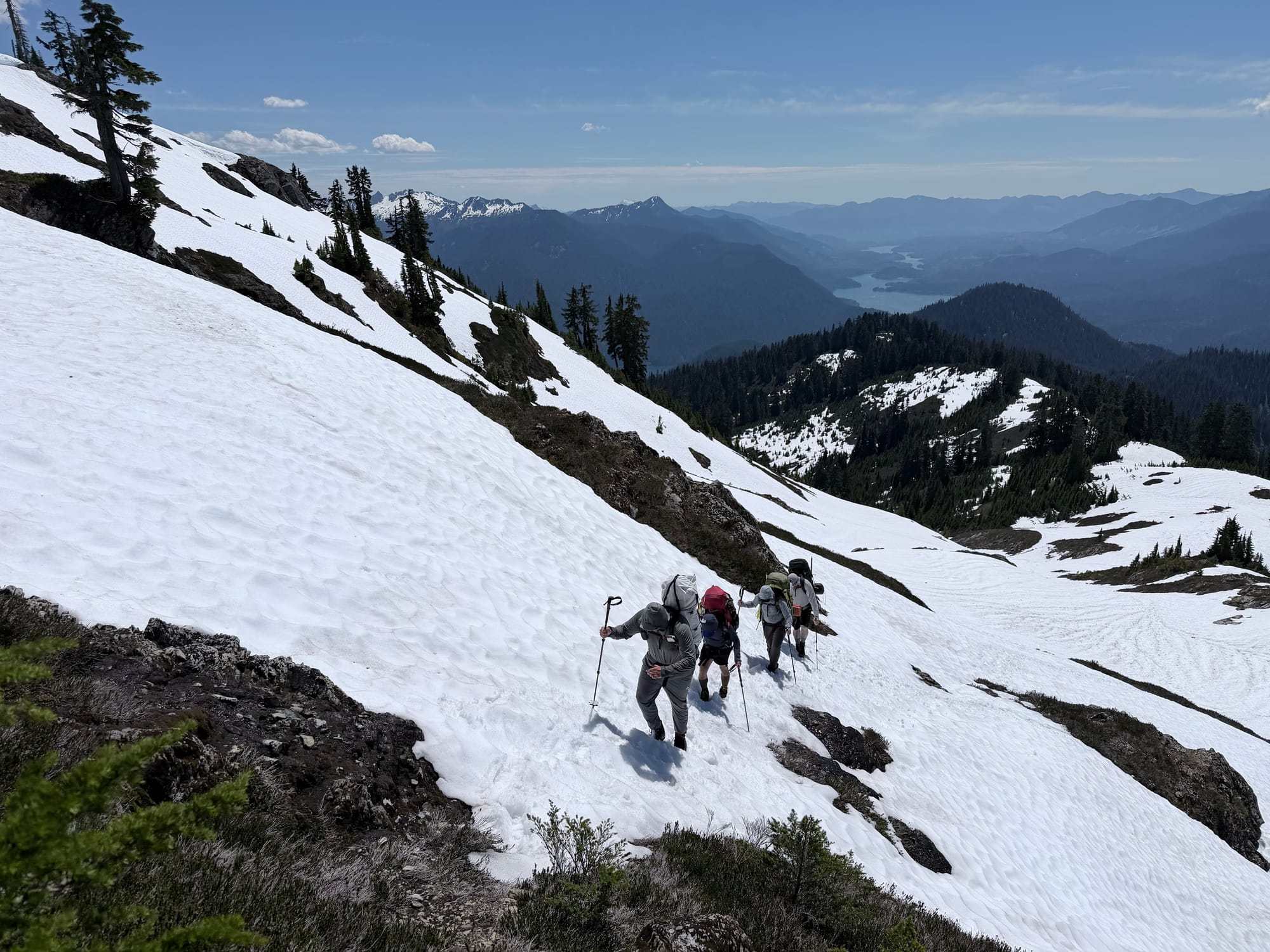
After gaining the ridge at 5,400 feet, we stowed a pole and added an ice axe and helmets before making the curving northeasterly traverse of a steep snowfield. We noticed a couple of tents on the ridge to climber's left and soon encountered a party of women who had camped there the previous night, returning from their successful summit day. They were happy to hear that their tents had survived, as the wind was strong for much of the day.
When we were about 300 feet below our destination, we paused for some much-needed rest. The students on our climb were carrying heavy loads and we later realized that one of them was carrying a pack weighing almost 40% of his body weight. He didn't complain at all, just saying that he needed a break. This was quite a contrast to my last Shuksan trip where none of the students volunteered to carry the rope, all trying to keep their packs as light as possible.
Finally, we reached a snowy plain at 6,300 feet where most climbers set up camp. There are two main options: a lower camp to climber's right at 48.80180, -121.60300 and a slightly higher camp to climber's left at 48.80325, -121.61111. We chose the lower camp, finding a rocky outcrop with two flat spots for tents and a backcountry toilet that was snow-free and open for business. Note: the toilet is to the east and downhill from the camp by about 100 feet, providing some privacy and beautiful, unobstructed views while doing your thing, but requiring a hike back up to camp afterward. I think most people will find it easier to navigate this while there is still daylight. An advantage of the lower camp is the ridge to the west blocks the sun a little earlier in the evening than is possible in the higher camp, making it easier to get to sleep early.
The view from camp
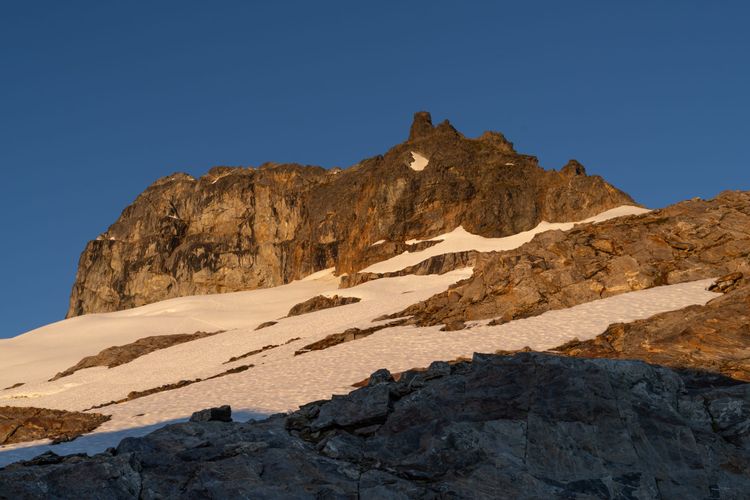
Water was available downhill from the rocks, so melting snow was unnecessary. Our group carried four fuel canisters for seven people in case we needed to melt snow, but used only a fraction of a single canister for the entire trip. After replenishing our water supply and eating dinner, we studied the mountain, trying to plot our summit route. From our vantage point in camp, the snow colouir running up the southern aspect of the pyramid looked impossibly vertical, but this ultimately proved to be the correct route. After a quick review of running picket belays and discussing rope teams, we settled into our tents at 8:30 PM, planning for a 3:30 AM alpine start.
Thankfully, I was able to get about 5 hours of sleep, which was much needed because I hadn't slept well the night before. The anticipation of a trip often keeps me awake, thinking about all of my contingency plans and feeling the pressure of needing to sleep. I've found that earplugs and an eye mask really help and now carry these on all of my overnight trips. My sleep system consisted of a Therm-a-Rest NeoAir XTherm NXT sleeping pad, a Feathered Friends Vireo sleeping bag and down-filled insulating jacket, pants and booties. This highly packable combination kept me warm all night while camping on snow with temperatures in the mid-30s.
Our 3:30 AM start shifted to 4:00 AM as everyone took a little longer to get ready than anticipated. We had two rope teams—a lead team of four led by Cameron and including Ed, Ron and Dean. The second rope of three included Matt, myself and Joe. It made the most sense for me to be in the middle of my rope as the other two guys were larger and team arrest would be more achievable in this configuration.
As we ascended above the camp plateau, the eastern sky began to light up and soon our headlamps were unnecessary. We tried to time our climb so would have light when we reached the summit pyramid and due to our later start, this was not going to be an issue. When we started our climb, we noticed two headlamps from far down the mountain and eventually, a team of two caught up and passed us, a younger man and woman who were making excellent time.
We eventually gained a ridge that was super windy on my last trip, but nearly still today. Baker was now basking in the sun's early morning glow, painted in pink and yellow hues.
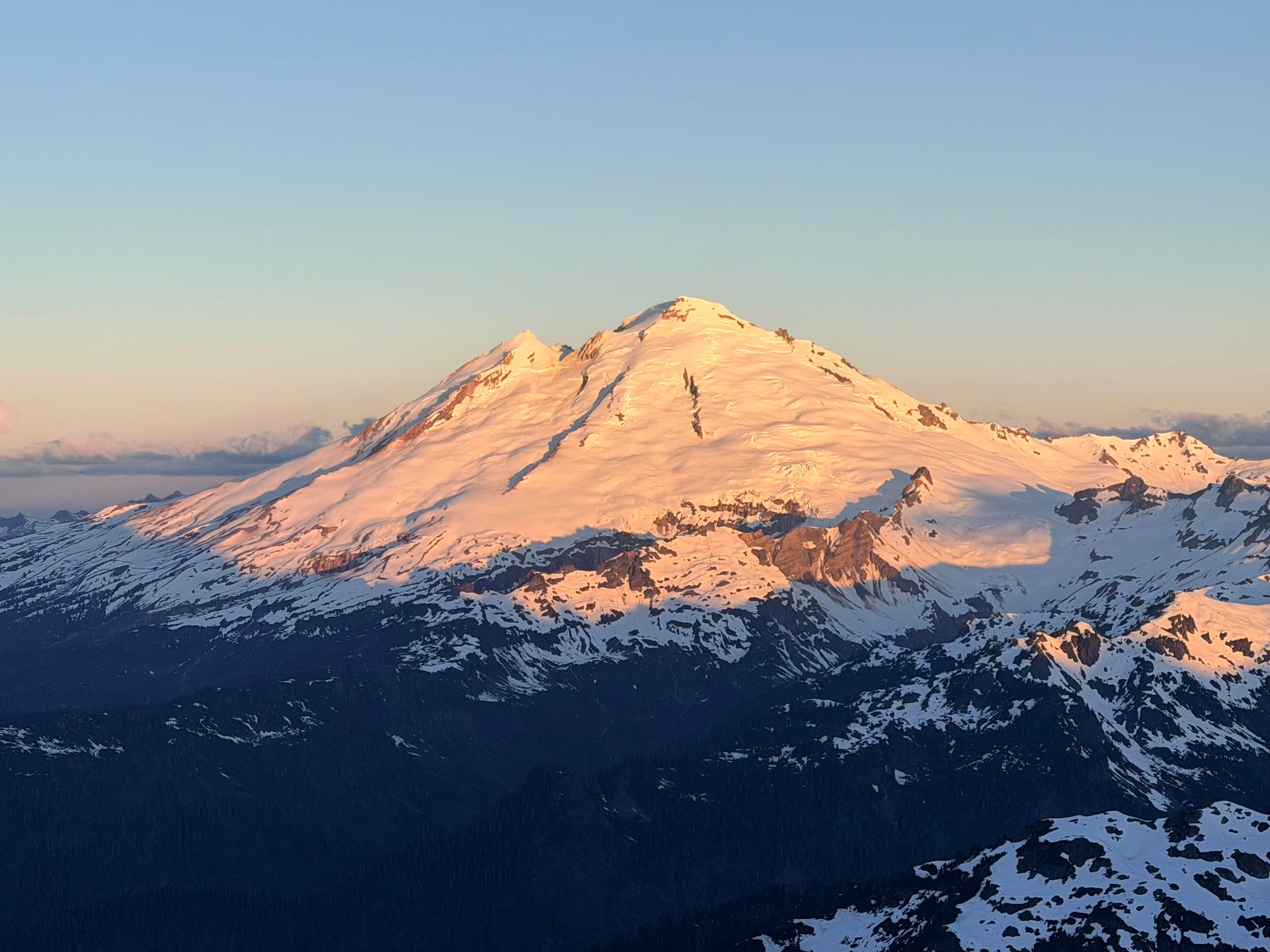
From here, we climbed steadily upward, following a good boot pack with Shuskan directly in front of us. While the overnight temperature remained above freezing, the surface must have been colder as the snow was mostly firm and supportable to all but the biggest guys in our group, who occasionally punched through.
As we neared the summit pyramid, we made a few stops to allow everyone to catch their breath. One of the members of our group wasn't feeling great and expressed doubts about completing the climb. We reassessed his condition at the base of the summit pyramid and it was clear he wasn't feeling strong enough to continue. We discussed options and decided that he would be safe to wait on a group of rocks until we returned, with ample food, fluids and a clothing to keep warm. He also carried a radio, allowing us to stay in contact until we returned. Ron moved from the first rope to ours, making two teams of three.
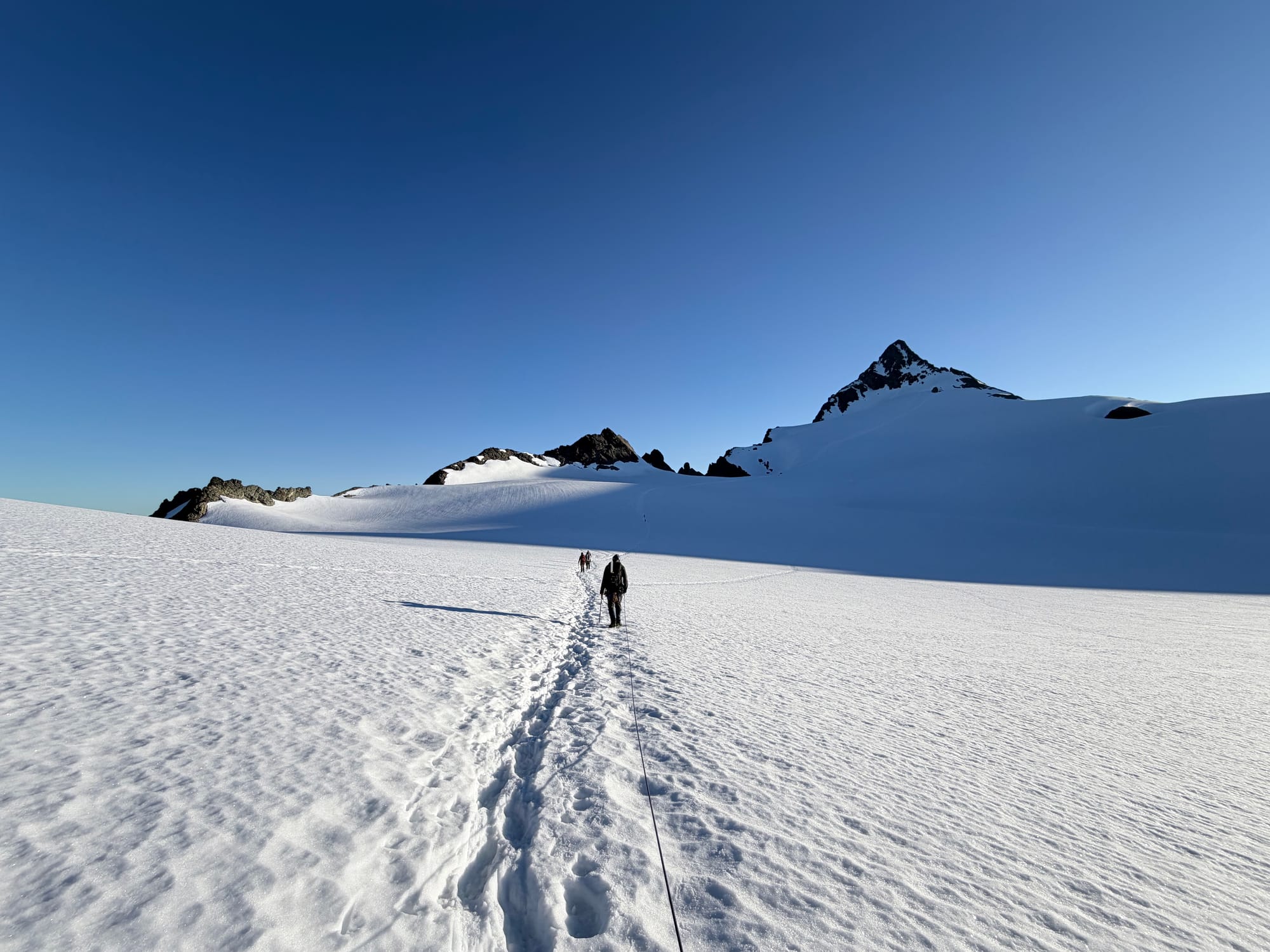
We started climbing up the pyramid at 8:00 AM. There was a reasonably good boot pack that wound diagonally up to climber's left and the snow remained firm and supportive, closer to the density of ice in places. We remained roped up for this section and all the way to the summit, but we noticed the previous two climbers who passed us earlier left their rope at the base. We later saw them down climbing from the summit with two ice tools. There's a case to be made for traveling this way, as it minimizes the risk of a rope team being unable to arrest and falling together on this very steep terrain. That said, everyone else we saw on the couloir that day were roped up.
We traveled slowly, using ice axe self belay technique. It was difficult to find placement for the axe spike at times since the snow was quite firm. There were many holes from prior climbers which could be used for the self belay. Dean called over the radio and we discussed whether placing pickets was necessary, but with good steps and the ability to self belay, we decided not to deploy them. The snow gully narrowed at times, requiring stepping over some exposed rocks, but otherwise remained intact to about 50 feet below the true summit.
As our group neared the top, Matt called out from behind me that I was losing my right crampon. I looked down and sure enough, the front of my crampon had slipped off the front of my boot, being held to my ankle by the straps. I tried unsuccessfully to pull it back into position with my hand. Fortunately we were close enough to the transition to rock that I was able to push forward, but had this happened lower down, the climb would have been much more complicated.
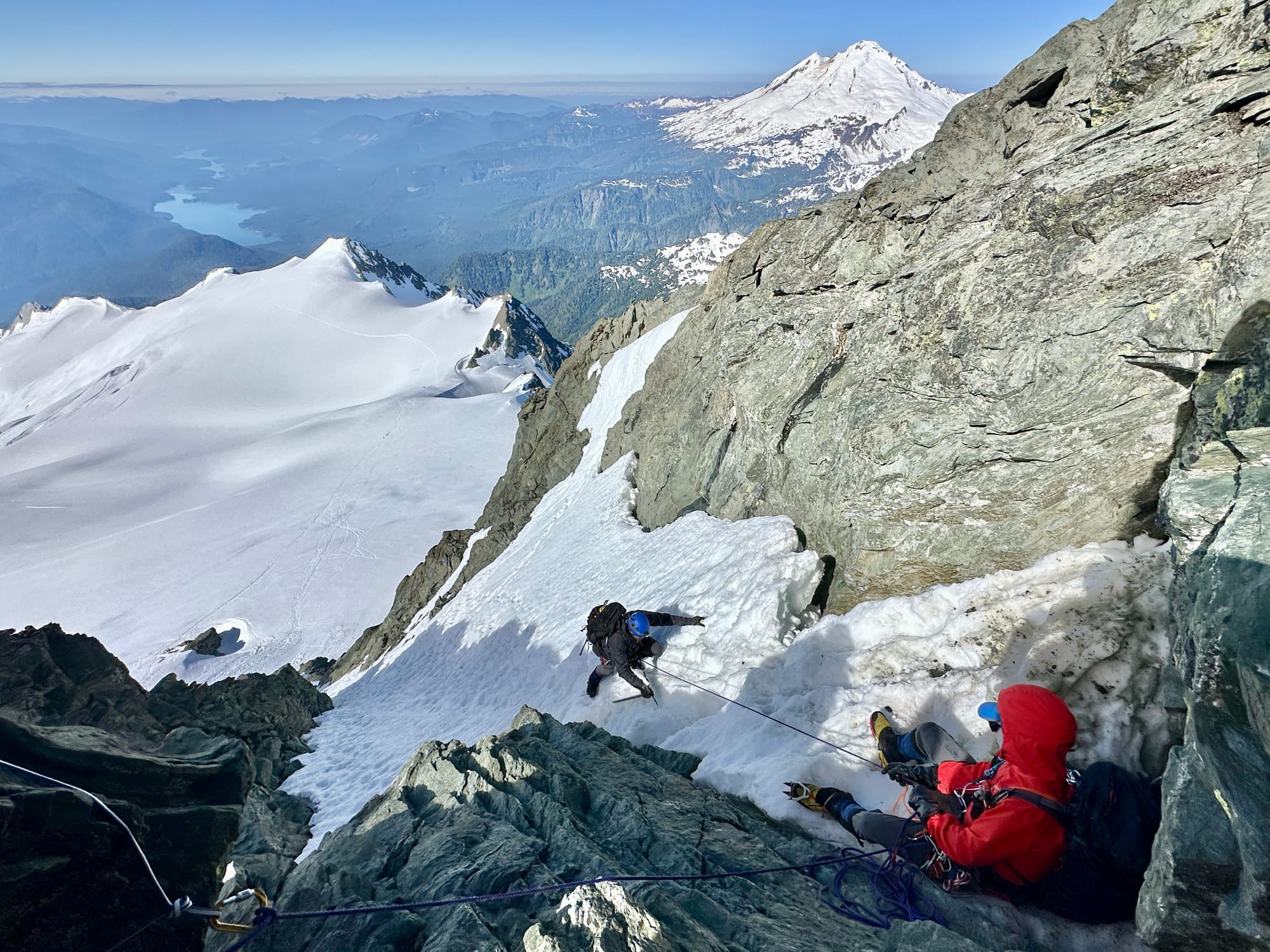
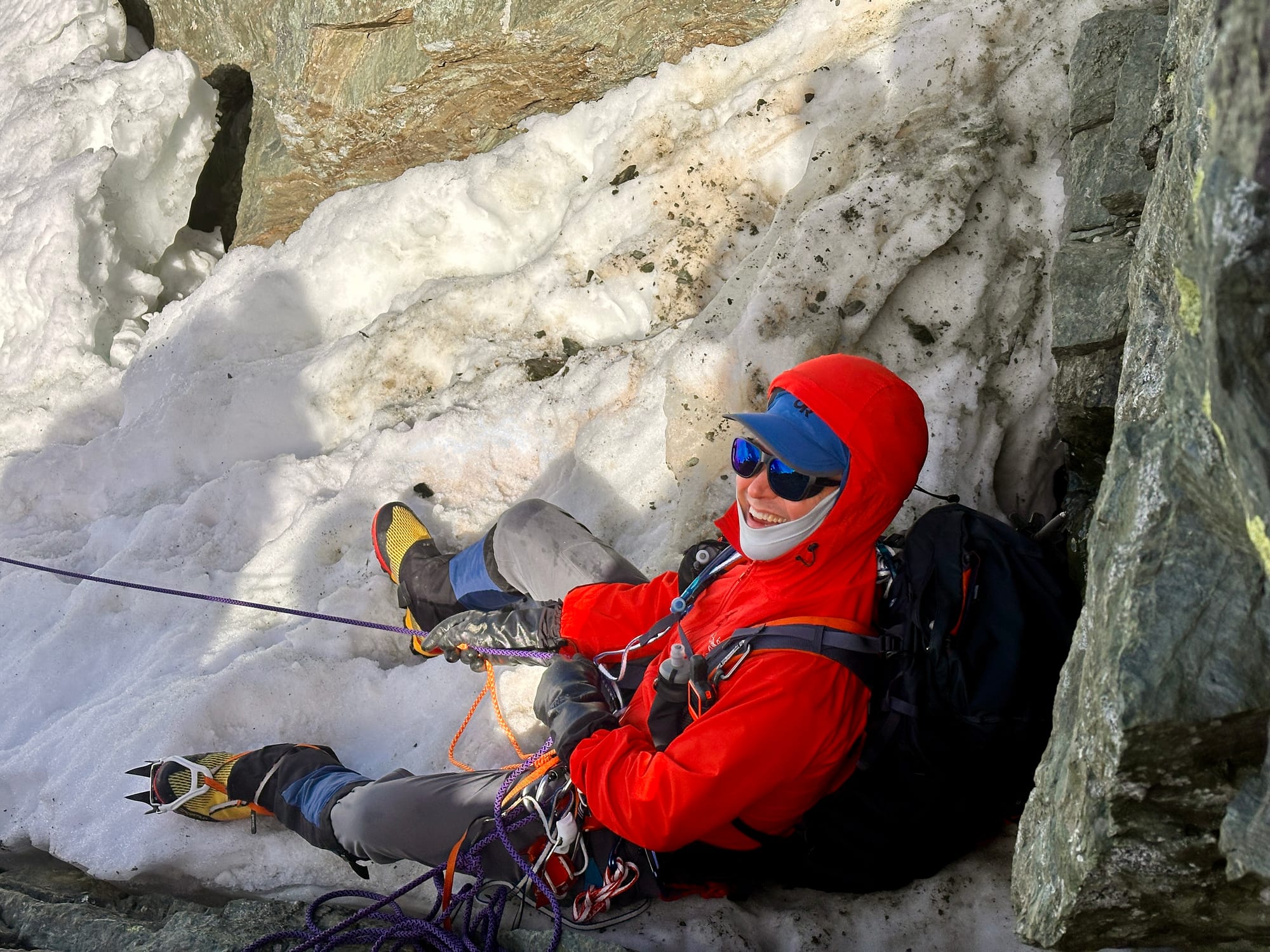
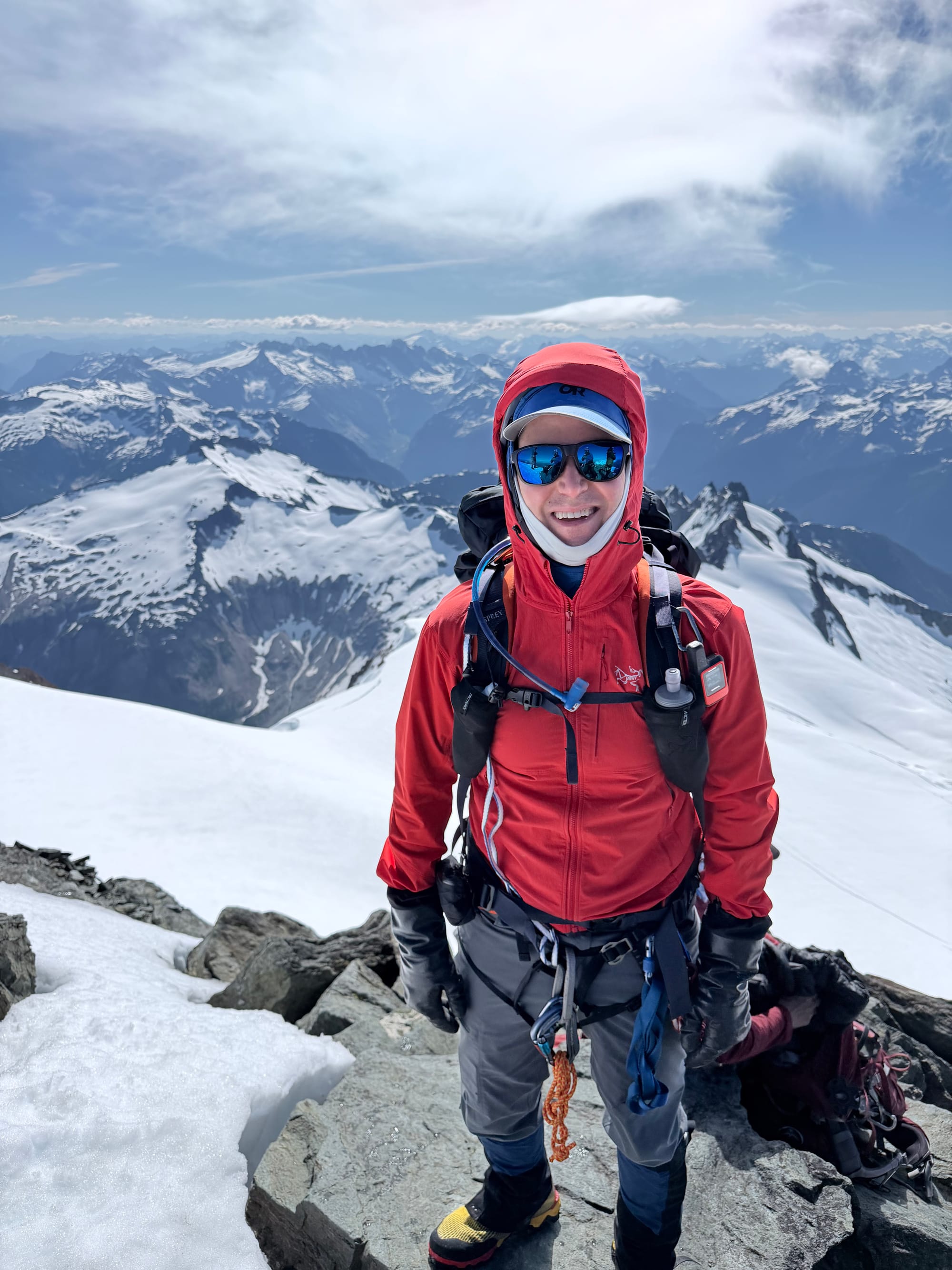
We made the transition to rock and completed a straightforward scramble to the summit, at times exposed, but not requiring any particularly difficult moves. The time at the top was 9:30 AM, about five and half hours after we left camp.
Summit panorama
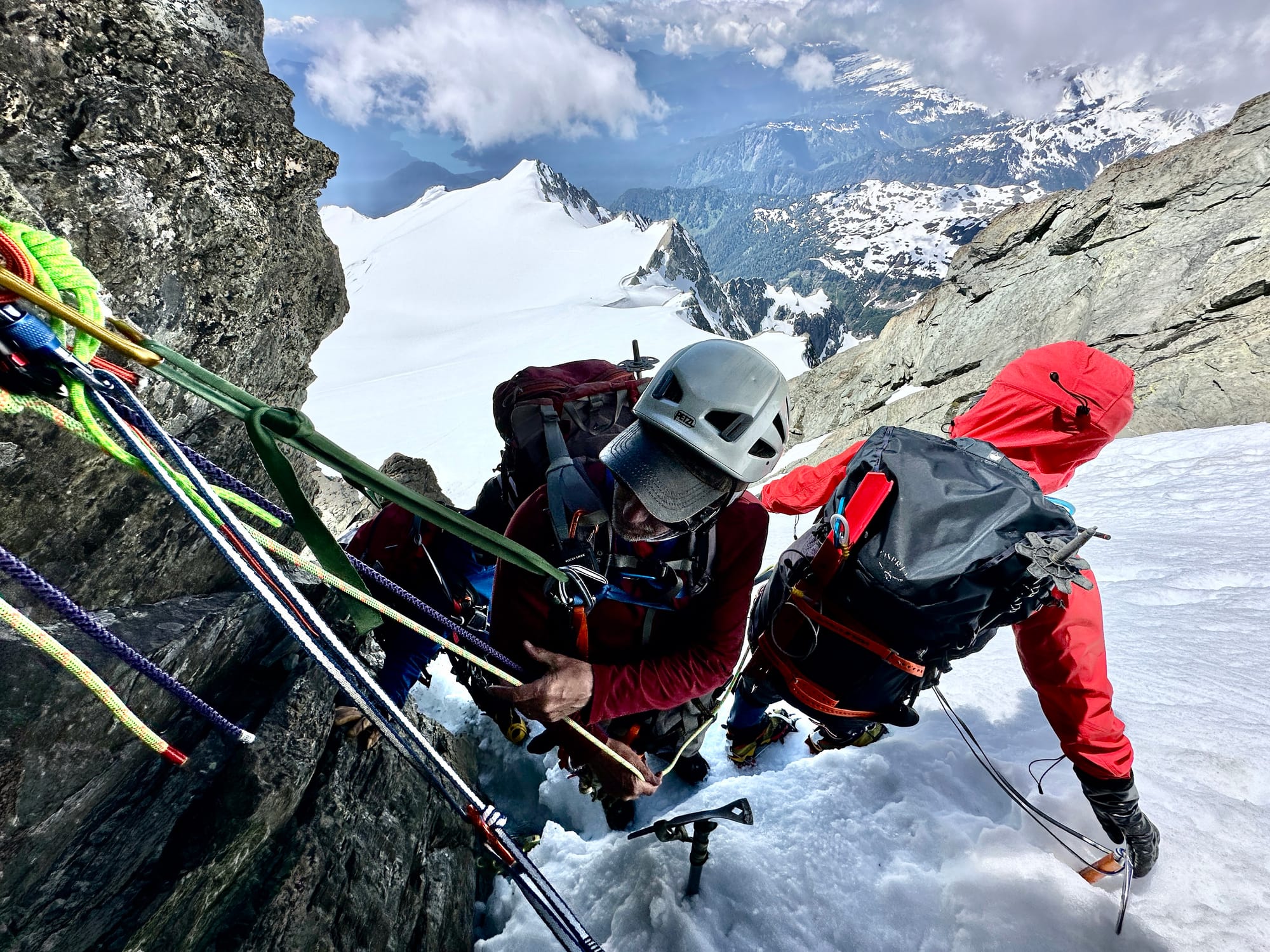
After enjoying the stellar summit views, we began our descent. We scrambled back down to the first rappel station just below the summit and began the first of four rappels on two 30 meter ropes tied together. With our group of six and more climbers coming up the couloir behind us, we made slow progress. The rappel stations did not line up perfectly every 30 meters, so we down-climbed from the end of the rope between stations. The snow platforms next to each station were very small, so not everyone in our group could tie in with their personal anchor while waiting to rappel. By 11:00 AM, the snow softened considerably and we were able to plunge step the final 200 feet to the base of the summit pyramid. We rejoined our waiting climber, then headed back to camp, arriving before 4:00 PM.
We took an hour to pack up camp, then made the long hike out to the trailhead, arriving at 8:45 PM. Since it was so late, there were no good food options near the trailhead, so we stopped at Wendy's in Burlington for burgers/Baconators to fuel the long drive home.
Starting elevation: 2,581 ft | Elevation Gain: 6,528 ft
Max elevation: 9,134 |Distance: 14.6 mi
Equipment: poles, helmet, crampons, glacier rope, ice axe, snow shovel, picket (not used)
Comments ()